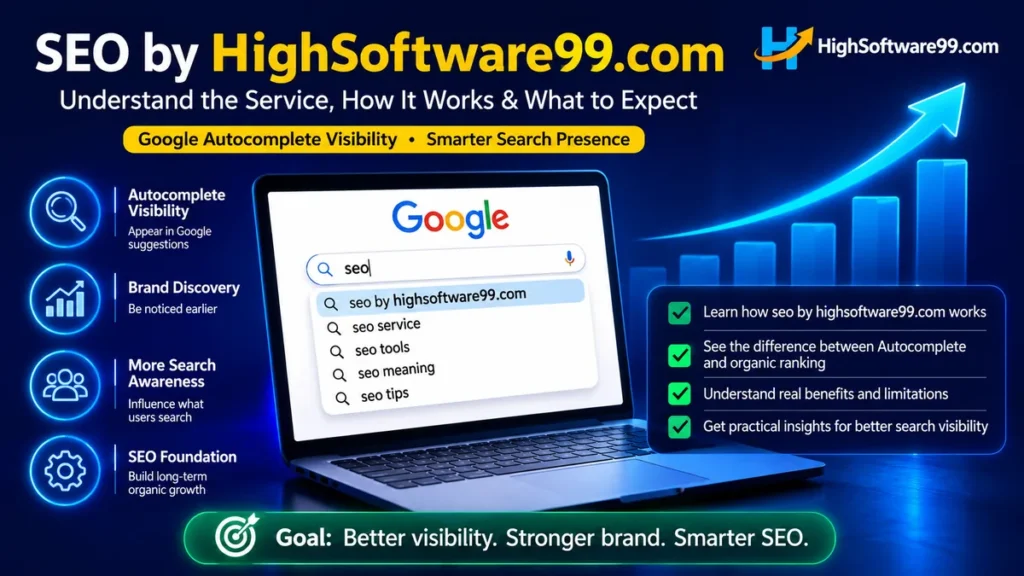
Search engine optimization normally works on a long timeline. A site improves its technical health, publishes useful content, earns authority, and gradually becomes more visible for relevant searches. That is why the phrase seo by highsoftware99.com stands out: HighSoftware99.com prominently markets an SEO service connected with Google Autocomplete visibility and claims that targeted keywords can appear within hours.
That claim needs context. Google Autocomplete and Google’s organic search rankings are different systems and should not be treated as interchangeable. Google’s own documentation says Autocomplete predictions are automatically generated using signals that include real searches, language, location, trending interest, and—in some circumstances—a user’s previous searches. Organic results, meanwhile, are selected from Google’s index based on relevance, quality, and many other signals.
Quick answer: seo by highsoftware99.com refers to SEO services associated with HighSoftware99.com, particularly its advertised Google Autocomplete or “ATC” visibility service. The company’s website claims rapid Autocomplete visibility, while also presenting broader digital-marketing and SEO capabilities. Autocomplete exposure can influence what searchers notice, but it is not the same thing as earning a top organic Google ranking.
What Is seo by highsoftware99.com?
At the center of the topic is HighSoftware99.com, whose public website describes its offering as “Google Auto Complete / ATC Services.” The site says it can boost keywords through Autocomplete within approximately 3–12 hours and demonstrates searches such as “seo” in the United States and “seo service” in India.
The same website also presents a wider set of digital services, including SEO/SEM, content creation, digital marketing, brand strategy, social-media management, and web design.
This creates an important distinction for anyone researching the term.
There are really two concepts to understand:
- Traditional SEO — improving pages and websites so they can be crawled, indexed, understood, and ranked for relevant searches.
- Autocomplete visibility — appearing as a suggested query while someone is typing into Google’s search box.
Several independent pages discussing the brand make the same distinction, describing its most unusual or recognizable feature as Autocomplete-focused visibility rather than ordinary organic ranking alone.
Understanding that difference is essential before judging what the service can realistically accomplish.
How Google Autocomplete Actually Works
Google Autocomplete is designed to help people complete searches faster. As someone begins typing, Google generates predictions for queries that its systems consider useful and relevant.
According to Google’s documentation, those predictions can depend on:
- searches that people have actually performed;
- the language of the query;
- the searcher’s location;
- current or trending interest;
- previous searches when personalization applies;
- words and phrases found across the web.
This explains why two users may not always see identical suggestions.
A query that appears prominently in one country may be absent somewhere else. A trending query may become visible temporarily and later disappear. Personalized activity can also affect what an individual sees.
That makes Autocomplete fundamentally different from a fixed advertising placement.
Autocomplete Is Not an Organic Ranking Position
This is perhaps the most important point about seo by highsoftware99.com.
Suppose someone types:
seo
and Google suggests:
seo by highsoftware99.com
That means the phrase is appearing as an Autocomplete prediction for that search context.
It does not automatically mean HighSoftware99.com holds Google’s number-one organic result for “seo.”
After the user submits a query, Google enters the normal search-results process. Its systems search Google’s index and select pages they consider relevant and high quality using many signals. Location, language, device, content relevance, and other factors can affect the results displayed.
So the search journey can be viewed as two separate stages:
| Stage | What Happens | Main Purpose |
|---|---|---|
| Autocomplete | Google predicts possible queries | Help users complete a search |
| Organic results | Google selects indexed pages for the submitted query | Return relevant search results |
A business can potentially gain visibility at the first stage without automatically controlling the second.
Why Autocomplete Visibility Can Be Valuable
Even though Autocomplete is not an organic ranking, appearing there can still have marketing value.
Search suggestions appear before a user has completed the query. That puts them at an unusually early point in the discovery process.
Imagine a person begins searching for a general service and encounters a branded suggestion they have never seen before. The suggestion can introduce that brand before the search-results page even loads.
Brand Discovery
Autocomplete can expose users to a name or phrase they might not otherwise have searched.
Repeated exposure may also make a brand more recognizable. Someone who has encountered a name several times may remember it later when comparing providers.
Query Influence
Suggestions can change what people ultimately search.
A person may begin with one idea and select a more specific suggestion after seeing it in the search box. In that sense, Autocomplete can influence query selection rather than simply responding after the search has happened.
Branded Search Visibility
For businesses, branded queries are particularly interesting because they can indicate that users already know—or have recently discovered—the brand.
Autocomplete exposure therefore has potential as a discovery channel.
But none of these benefits remove the need for a useful destination page.
If users click or search a suggested phrase and discover an irrelevant, slow, confusing, or untrustworthy website, the initial visibility has accomplished very little.
seo by highsoftware99.com vs Traditional SEO
The biggest mistake is treating Autocomplete visibility as a replacement for traditional SEO.
It makes more sense to view the two as different layers of search visibility.
| Factor | Autocomplete Visibility | Traditional Organic SEO |
|---|---|---|
| Appears before query submission | Yes | No |
| Guarantees an organic position | No | No |
| Can influence query choice | Yes | Indirectly |
| Requires crawlable/indexable pages | Not in the same way | Yes |
| Content quality matters | Indirectly | Strongly |
| Technical SEO matters | Not its main function | Yes |
| Backlinks may influence organic visibility | Not a direct Autocomplete equivalent | Can contribute to authority/discovery |
| Search intent matters | Yes | Yes |
| Results may vary by location | Yes | Yes |
| Personalization can affect visibility | Yes | Depending on search context |
Traditional SEO remains broader because it addresses what happens after a searcher submits a query.
Google’s Search Essentials recommends creating helpful, reliable, people-first content and using terms people actually search for in prominent, descriptive locations such as titles, headings, alt text, and link text.
That work cannot simply be replaced by obtaining an Autocomplete suggestion.
What a Sustainable SEO Strategy Still Requires
Whether a website uses HighSoftware99.com, another SEO provider, or an internal team, several fundamentals remain important.
1. Search Intent and Useful Content
A page needs to satisfy the reason behind the search.
Someone asking “how does Google Autocomplete work?” needs an explanation. Someone searching for a specific company may want information about its services, reputation, pricing, or contact details.
Those are different needs.
Successful content addresses the actual question rather than repeatedly inserting a target keyword.
Google’s current guidance for both conventional Search and generative AI features emphasizes creating content that visitors find useful and satisfying. Google also warns against producing separate pages for numerous query variations primarily to manipulate rankings or generative AI responses.
2. Technical Accessibility
Excellent writing cannot perform well organically if search engines struggle to access the page.
Technical SEO commonly involves checking:
- crawlability;
- indexing directives;
- internal navigation;
- mobile usability;
- page performance;
- canonicalization;
- structured data where appropriate;
- XML sitemaps;
- server errors and redirects.
Google notes that indexing problems can arise from low-quality content, robots directives, or website designs that make pages difficult to process.
The objective is simple: make useful pages easy for both visitors and search engines to access.
3. Clear Site Architecture
Search engines need context.
A website with hundreds of disconnected articles is harder for users to navigate than one organized around clear subjects and relationships.
For example, an SEO website could organize information around:
- technical SEO;
- keyword research;
- content optimization;
- internal linking;
- search visibility;
- analytics and measurement;
- AI search;
- Google Search Console.
Relevant internal links can connect those subjects and guide readers toward deeper explanations.
This approach is more useful than creating large numbers of nearly identical pages targeting tiny keyword variations.
4. On-Page Optimization
On-page SEO helps both search engines and readers understand a page.
Good optimization typically includes a descriptive title, a clear H1, logical H2/H3 headings, useful internal links, descriptive image alt text where appropriate, and concise explanations that answer the searcher’s main question quickly.
Keyword placement matters, but repetition is not a strategy.
Google specifically classifies unnatural repetition of words or phrases for ranking manipulation as keyword stuffing.
Write the page for the reader first and use terminology naturally where it adds clarity.
What About Backlinks?
Links remain part of the wider web ecosystem, but how they are acquired matters.
A useful link normally exists because another publisher genuinely wants to reference a resource, brand, study, tool, or explanation.
Problems arise when links are created primarily to manipulate rankings.
Google’s spam policies specifically identify practices such as buying or selling links for ranking purposes, automated link creation, excessive link exchanges, low-quality directory links, and optimized links in paid articles that pass ranking credit as examples of link spam.
Paid placements are not automatically forbidden, but Google says qualifying them appropriately with attributes such as rel="sponsored" or rel="nofollow" prevents them from improperly passing ranking credit.
For anyone evaluating an SEO provider, “we build backlinks” therefore isn’t enough information.
A better question is: how are those links obtained?
Can seo by highsoftware99.com Produce Instant SEO Results?
This depends entirely on what “results” means.
HighSoftware99.com’s public website explicitly advertises rapid Google Autocomplete/ATC visibility, stating a 3–12-hour timeframe for its Autocomplete offering.
That claim should not be translated into “Google organic rankings in 3–12 hours.”
Google itself says meeting its technical requirements and best practices does not guarantee that a page will be crawled, indexed, or served in Search.
It is therefore useful to separate four outcomes:
Discovery: Google finds the URL.
Indexing: Google processes the page and may add it to its index.
Ranking: The page earns visibility for particular queries.
Autocomplete visibility: A query or phrase appears among Google’s predictions.
These outcomes can occur on completely different timelines.
A newly published page can be discovered quickly without ranking competitively. Likewise, an Autocomplete prediction can appear without the corresponding website holding the top organic result.
Any SEO claim should therefore specify exactly which outcome is being measured.
Is Google Autocomplete the Same Everywhere?
No.
Google explicitly states that Autocomplete predictions can consider the query’s language, the user’s location, trending interest, and previous searches.
That has practical consequences when testing an Autocomplete campaign.
If a phrase appears for one person, that single screenshot does not necessarily prove universal visibility.
A more meaningful evaluation would examine the intended market and test:
- different devices;
- signed-in versus less-personalized conditions where practical;
- multiple relevant locations;
- the exact starting characters or phrase;
- visibility over several days rather than one moment.
The same principle applies to SEO reporting generally: define what is being measured before deciding whether performance improved.
How to Evaluate HighSoftware99.com or a Similar Service
The most useful evaluation starts with specific questions rather than promises.
Ask What the Deliverable Actually Is
“SEO” can describe dozens of activities.
Determine whether you are purchasing:
- Autocomplete visibility;
- an SEO audit;
- technical fixes;
- keyword research;
- content production;
- on-page optimization;
- link acquisition;
- local SEO;
- analytics and reporting;
- or a combination of services.
If the main deliverable is Autocomplete visibility, judge it as an Autocomplete campaign rather than comparing it directly with organic ranking work.
Ask How Success Is Measured
A campaign needs a measurable baseline.
For organic SEO, useful measurements can include impressions, clicks, indexed pages, rankings for relevant query groups, conversions, and organic landing-page performance.
Google Search Console is particularly useful because it provides information about how Google crawls, indexes, and serves a website. Its URL Inspection and performance tools can help diagnose individual pages and monitor search visibility.
Google also announced dedicated Search Generative AI performance reporting in Search Console in June 2026, initially rolling it out to a subset of sites. The reports are designed to show visibility within generative AI features such as AI Overviews and AI Mode.
For Autocomplete, measurement requires a different framework because an Autocomplete prediction is not an organic Search Console position.
Ask About Risk
Fast results are attractive, but speed alone tells you little about sustainability.
Google’s spam policies cover manipulative techniques including link spam, scaled content abuse, cloaking, doorway abuse, and keyword stuffing. Violations can cause pages or entire sites to rank lower or disappear from search results.
Before hiring any SEO provider, ask what techniques are used rather than relying only on screenshots or headline results.
Where AI Search Fits Into the Picture
Search visibility in 2026 is broader than ten blue links.
Google Search includes AI-driven experiences alongside traditional results, but that does not mean publishers need an entirely separate “AI SEO” system.
Google’s guidance says the fundamentals that help with Search also apply to its generative AI experiences. It recommends useful content, strong page experience, accessible textual information, relevant images or video when appropriate, and compliance with Search Essentials.
This reinforces an important principle: optimizing for users remains more durable than chasing every new search feature independently.
Autocomplete, organic listings, featured answers, and AI experiences may expose content differently, but weak pages do not become strong resources merely because they target more search surfaces.
Can AI-Generated Content Be Used for SEO?
Yes, but the method matters.
Google’s guidance does not say that content becomes unacceptable simply because generative AI assisted with its creation. Instead, the concern is whether the resulting content adds genuine value and complies with Search Essentials and spam policies.
Google specifically warns that generating many pages without adding value can violate its scaled content abuse policy.
For practical SEO work, AI can help with tasks such as organizing research, identifying missing subtopics, structuring drafts, and improving workflows.
Human review still matters.
Facts should be checked. Examples should make sense. Claims need evidence. Content should add something useful rather than simply repackage what already ranks.
Common Mistakes When Chasing Faster Search Visibility
The promise of quick visibility can encourage decisions that hurt long-term performance.
Confusing Indexing With Ranking
A page appearing in Google’s index does not mean it ranks competitively.
Indexing makes ranking possible; it does not guarantee it.
Confusing Autocomplete With Organic Results
An Autocomplete prediction happens before the final search.
An organic position happens after the query is submitted.
Treat them as separate metrics.
Publishing Near-Duplicate Keyword Pages
Creating hundreds of slightly different articles for similar phrases can lead to thin, repetitive content.
Google explicitly warns against scaled production designed primarily to manipulate rankings rather than help users.
Buying Links Without Understanding Their Source
A large backlink count means little when the links are irrelevant, automated, or created purely for manipulation.
Quality, context, editorial relevance, and proper link qualification matter more than a raw number.
Measuring Only Rankings
Rankings are useful, but they are not the entire outcome.
A business should also consider relevant traffic, qualified leads, conversions, revenue, engagement, and whether its pages actually solve users’ problems.
A Safer Framework for Combining Autocomplete and Organic SEO
If Autocomplete visibility is part of a marketing strategy, it does not need to compete with traditional SEO.
The two can serve different purposes.
Step 1: Build a Search-Ready Website
Make sure important pages are crawlable, indexable, mobile-friendly, logically organized, and useful.
Step 2: Create Strong Destination Pages
If an Autocomplete suggestion introduces people to your brand, make sure the resulting search leads to a page that clearly explains who you are and why the visitor should trust the information.
Step 3: Develop Topical Coverage
Build genuinely useful resources around the questions your audience has rather than publishing endless keyword variations.
Step 4: Earn Authority
Create resources worth referencing and develop legitimate relationships within your industry.
Avoid treating backlinks as a simple volume target.
Step 5: Use Autocomplete as an Additional Visibility Layer
If a legitimate Autocomplete strategy provides useful brand discovery, measure it separately from organic rankings.
Step 6: Track the Outcomes
Use Search Console and analytics to determine what actually changes.
Watch impressions, clicks, queries, landing pages, conversions, indexing, and other metrics relevant to the campaign instead of relying on a single screenshot.
What Should You Expect From seo by highsoftware99.com?
Based on the company’s publicly accessible website, its standout proposition is rapid Google Autocomplete visibility, alongside broader digital-marketing and SEO-related services.
The important question is not whether Autocomplete exists—it clearly does—but what a particular service can reliably influence, how that influence is produced, how long it persists, and whether the methods fit Google’s policies.
Users considering the service should therefore separate verifiable facts from marketing claims.
The company can describe its methods and provide campaign evidence. Google can explain how its own Search and Autocomplete systems operate. Those two sources answer different questions.
Independent evaluation requires comparing both.
The Bottom Line on seo by highsoftware99.com
seo by highsoftware99.com is best understood as a branded SEO topic associated particularly with HighSoftware99.com’s Google Autocomplete/ATC offering, rather than as a new type of Google organic ranking algorithm. Its official website advertises fast Autocomplete visibility, while Google explains that Autocomplete predictions are generated automatically using signals such as real searches, language, location, trends, and personalization.
That distinction changes how the service should be evaluated.
Autocomplete visibility may contribute to brand discovery and influence which query a user chooses, but it should not be confused with indexing, organic rankings, technical SEO, content quality, or sustainable authority.
For long-term search performance, the fundamentals remain remarkably consistent: build accessible pages, satisfy search intent, publish useful original information, organize the site clearly, earn legitimate authority, and measure results with reliable data.
Google’s current Search and AI guidance continues to emphasize the same underlying principle—create content and experiences that people genuinely find useful rather than producing pages or using techniques primarily to manipulate search systems.
That is the most useful lens through which to judge seo by highsoftware99.com, or any other SEO service promising unusually fast visibility.