
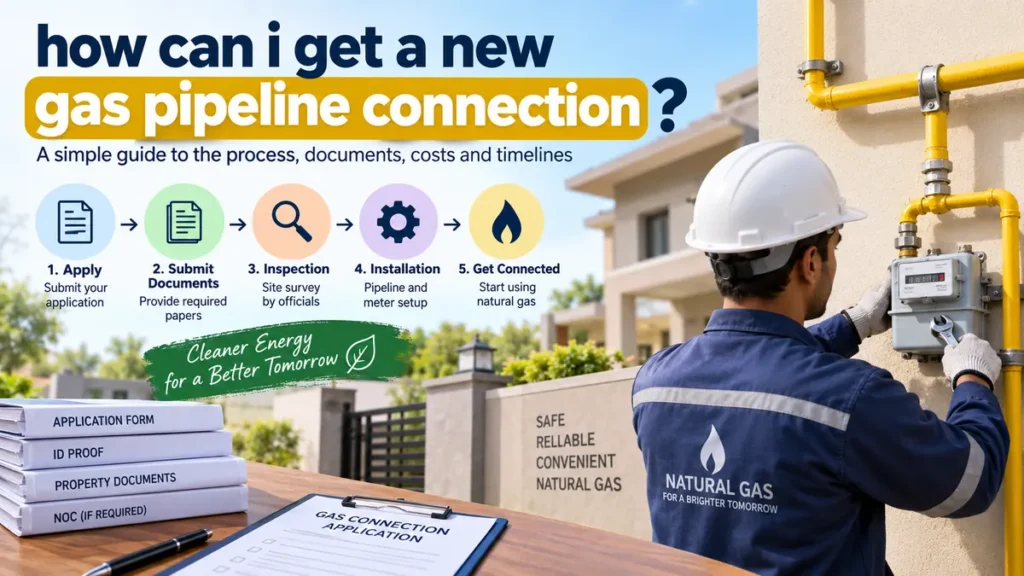
Getting a new piped-gas connection in Pakistan has changed significantly in recent years. For domestic applicants, the process now largely revolves around RLNG (Regasified Liquefied Natural Gas) connections, and the exact application route depends on whether your property falls under Sui Northern Gas Pipelines Limited (SNGPL) or Sui Southern Gas Company Limited (SSGC).
If you are wondering how can i get a new gas pipeline connection, start by confirming that a gas distribution line already passes your property. Then apply to the gas company serving your region, provide your CNIC and property documents, complete the required survey and verification, pay the applicable demand notice and security/service charges, and wait for service-line and meter installation.
This guide explains the current process, what documents you should prepare, how RLNG affects new applicants, what happens after you apply, and the common issues that can delay or stop a connection.
how can i get a new gas pipeline connection in Pakistan?
Pakistan’s two main gas distribution companies cover different parts of the country:
| Gas company | Main service areas | Current domestic connection route |
|---|---|---|
| SNGPL | Punjab, Khyber Pakhtunkhwa and other areas within its network | New domestic RLNG connection |
| SSGC | Sindh and Balochistan | New domestic RLNG connection |
For applicants in SNGPL territory, the company’s official online system currently identifies the service as an Online Application for RLNG Domestic Gas Connection. SSGC also provides an online application specifically for new RLNG domestic connections.
That distinction matters. A person who remembers the older process of simply applying for a conventional domestic natural-gas connection may encounter different tariffs and conditions today.
The basic process at a glance
A typical new connection follows these steps:
- Identify whether SNGPL or SSGC serves your location.
- Confirm that the company’s gas pipeline/network reaches your premises.
- Prepare your CNIC and proof of property ownership or other required property documents.
- Obtain details of a nearby gas connection where requested.
- Complete the domestic RLNG application.
- Submit the application and keep your reference number.
- Wait for document scrutiny and a site survey.
- Receive approval if the connection is technically feasible.
- Pay the applicable demand notice, deposit and service charges.
- Complete any required internal house-piping arrangements.
- Wait for the service line and gas meter to be installed.
- Keep the first bill and connection records for future reference.
The individual steps can vary according to your company, location, property and network conditions.
First check whether a gas pipeline reaches your property
One of the most overlooked requirements is also one of the most important: pipeline availability.
Submitting an application does not mean a company can automatically connect your home.
SNGPL explicitly states that an online domestic RLNG application should be made only for premises falling on its gas network. Its application form also asks applicants to confirm that an SNGPL gas pipeline exists in front of the premises.
SSGC’s current application material similarly requires confirmation that an SSGC gas pipeline exists in front of the property.
How can you check pipeline availability?
A practical first check is to look at neighboring properties.
If houses immediately beside or opposite your property already have active gas meters, write down the nearest customer or meter information with the neighbor’s permission. Both companies may use nearby connection details to identify the distribution network serving the location.
SNGPL’s online form includes a field for the nearest consumer number. SSGC asks for the nearest customer number and nearest meter number in its RLNG application.
This information is useful, but a neighbor having gas does not by itself guarantee approval. The gas company still determines technical feasibility through its records and, where required, a physical site survey.
What if there is no pipeline in front of the house?
A standard individual domestic connection generally depends on access to the existing distribution network.
If the nearest main is some distance away, the issue may involve a gas-main extension rather than a routine service connection. SNGPL separately lists an application/form category for extension of gas mains, indicating that network extension is treated differently from an ordinary connection on an existing distribution network.
Do not pay a private person who promises to extend a public gas line or obtain an unauthorized connection. Network expansion and service-line work must follow the gas company’s approved procedures.
SNGPL new gas connection process
SNGPL is the relevant distributor for many households in Punjab and Khyber Pakhtunkhwa. Its current online application facility is specifically for domestic RLNG connections.
Step 1: Open the domestic RLNG application
Applicants can use SNGPL’s official online connection system. The company states that applicants can submit a new domestic application through its website rather than visiting an office merely to submit the initial online application.
SNGPL also provides its ConnectOn mobile application. Its listed features include applying for a new connection, checking application status, applying for reconnection, viewing bills, checking tariffs and locating offices. The app was updated in August 2026.
Step 2: Enter the property information carefully
The SNGPL form requests information such as:
- applicant’s name;
- father/husband details;
- CNIC;
- complete property address;
- nearest landmark;
- nearest consumer number;
- province, district and city;
- property-related information; and
- intended gas use, such as cooking, water heating or space heating.
Use the applicant’s name exactly as it appears on the CNIC.
SNGPL specifically warns against incomplete addresses and abbreviations. A clear nearest landmark can help identify properties where conventional street or house numbering is insufficient.
Step 3: Upload the documents
The current online form requires CNIC and property ownership documentation to be uploaded. SNGPL states that documents should be complete and legible and that the CNIC must be valid.
Prepare clear digital copies before beginning the form.
Step 4: Submit and save the reference number
After online submission, SNGPL can issue a provisional reference number.
Do not treat that number as connection approval.
The company states that an application remains subject to scrutiny, including verification of CNIC information, property documents, network availability, the address and applicable procedural requirements.
Save the reference number as soon as it is generated. You can use SNGPL’s online system to check an existing application’s status.
Step 5: Wait for scrutiny and feasibility checks
The company may check whether:
- your identity details match your CNIC;
- property documentation is acceptable;
- the address is genuine and sufficiently specific;
- the gas network exists at the property;
- the locality is legally recognized; and
- other current policy requirements are satisfied.
SNGPL warns that applications for localities declared illegal by the relevant development or local authority may be rejected.
Quick Takeaway
For an SNGPL applicant, the strongest application is not simply the earliest one. It is one with an accurate CNIC, clear ownership documents, a precise address, nearby consumer information where available, and an existing SNGPL distribution line at the premises.
SSGC new gas connection process
For households within SSGC’s service territory, the company currently provides a dedicated New RLNG Domestic Gas Connection Application.
The form collects more property and network information than many applicants expect.
Information requested by SSGC
The current application includes fields for:
- zone;
- application date;
- nearest customer number;
- nearest meter number;
- meters already installed at the property;
- number of floors;
- number of units or kitchens;
- premises type;
- plot size;
- number of connections requested;
- applicant’s name; and
- full address where gas is required.
Accurate information is particularly important for a multi-unit or multi-floor building because the number of kitchens, units and existing meters can affect how the premises is assessed.
SSGC documents you may need
SSGC’s published material identifies documents and information that can include:
- completed application form;
- valid CNIC;
- ownership documents;
- nearest neighbor’s gas bill or nearby customer/meter details;
- approved drawings or completion plan where applicable;
- NOC from a society or relevant authority where applicable; and
- property-related approvals required for the particular premises.
Requirements can vary with property type, so an applicant in an apartment building, housing society or tenancy situation may need documentation that an owner-occupied standalone house does not.
Documents required for a new gas pipeline connection
Documentation is one of the easiest parts of the process to control yourself.
A useful preparation checklist is:
| Document/information | Why it may be needed |
|---|---|
| Valid CNIC | Confirms applicant identity |
| CNIC front and back | Required for digital identity documentation |
| Property ownership papers | Establish the applicant’s relationship with the premises |
| Complete property address | Identifies the connection location |
| Nearest landmark | Helps locate the property |
| Neighbor’s gas bill/details | Helps identify the nearby gas network |
| Electricity bill | May be requested as supporting premises/address information |
| NOC | May apply to societies, tenants or regulated developments |
| Approved property plan | May apply under relevant local authority requirements |
| Mobile number | Used for applicant contact and records |
| Application reference number | Needed for status tracking |
SNGPL’s online form directly requires CNIC and ownership-document uploads, while a 2025 SNGPL public-information report concerning resumed connections also identified CNIC, a latest electricity bill, ownership papers and a neighboring gas bill among documents applicants should prepare.
SSGC’s published procedure lists the application form, ownership documents and CNIC, with a neighbor’s gas bill preferable and relevant authority NOCs required where applicable.
Because document requirements can change or depend on the property, always follow the checklist shown on the current official application rather than relying solely on an old printed list.
What is an RLNG gas connection?
RLNG stands for Regasified Liquefied Natural Gas.
Natural gas can be cooled into liquefied natural gas (LNG) for transport. After imported LNG reaches a receiving terminal, it can be converted back into gaseous form. That regasified supply is known as RLNG.
This distinction matters to new domestic applicants because the tariff may not be the same as the tariff associated with older domestic indigenous-gas connections.
SNGPL’s current portal labels new online domestic applications as RLNG Domestic Gas Connections. SSGC likewise operates a new RLNG domestic connection application.
Are existing consumers automatically being shifted to RLNG?
The reopening of new connections under an RLNG model should not be confused with automatically converting every existing household.
When SNGPL resumed the new-connection process in 2025, reporting on the policy said existing consumers were not being shifted wholesale to the new RLNG model, while new applicants would be subject to the RLNG-based framework.
For a person seeking a connection today, the practical lesson is simple: check the tariff category before accepting the connection and estimate your expected monthly cost accordingly.
New gas connection fees and demand notice
There is no single number that should be treated as a permanent nationwide gas-connection price.
Your total can depend on:
- gas company;
- current tariff and connection policy;
- property size;
- service-line requirements;
- security deposit;
- urgent processing, where available;
- internal piping;
- taxes or duties where applicable; and
- any special construction required at the premises.
For example, when SNGPL connections resumed under the RLNG framework in 2025, an official spokesperson quoted by Associated Press of Pakistan said a house up to 10 marlas had a Rs21,500 connection amount consisting of a Rs20,000 refundable security deposit and Rs1,500 service-line charge. Houses above 10 marlas had a Rs3,000 service charge, while an urgent connection involved an additional Rs25,000 fee.
Those figures are useful for understanding the fee structure, but they should not be treated as a permanent 2026 quotation. Connection charges and tariffs can be revised.
The amount shown on your official demand notice or current gas-company schedule is the amount that matters for your application.
What is a demand notice?
A demand notice is an official request for payment issued as the application progresses.
Depending on the connection and company, it may cover relevant connection charges, deposits or other approved amounts.
Never transfer a supposed connection fee to an individual’s personal account merely because someone claims they can arrange a meter faster. Verify the payment instructions through the gas company’s official system or customer service office.
What happens after submitting a new gas connection application?
Many applicants think submitting the form is the main hurdle. In reality, it starts the verification process.
1. Application registration
Your information is entered into the company’s customer or application system.
Keep screenshots, acknowledgment documents and the application/reference number.
2. Document scrutiny
The company reviews identity, ownership and property details.
Small inconsistencies can create avoidable problems. For example, the applicant’s name should match the CNIC, while the property address should be detailed enough for the premises to be located.
3. Site survey
A survey may be conducted to establish whether providing a connection is technically feasible.
The survey can confirm the location of the distribution main, property characteristics and practical service-line requirements.
SSGC’s published domestic connection procedure specifically includes document scrutiny followed by a site survey and feasibility approval.
4. Feasibility decision
If the site is feasible and the documents satisfy the requirements, the application can move toward approval.
If it is not feasible, the applicant may receive an intimation or rejection rather than a meter.
5. Payment and service agreement
After the applicable approval and payment stage, the customer relationship/service agreement can be created according to the company’s process.
6. Service line and meter installation
The service line connects the property’s approved gas installation to the distribution system. The gas meter measures consumption for billing.
SSGC’s published process places service-line and meter field activity after approval and creation of the service agreement.
7. Billing begins
After activation, meter readings are used to generate monthly bills under the applicable tariff.
Check the first bill carefully. Confirm the customer name, address, meter information and tariff category.
How long does a new gas connection take?
There is no reliable universal waiting period.
Processing depends on technical feasibility, application volumes, regional workload, available connection quotas or policies, documentation, service-line requirements and the applicant’s place in the processing sequence.
SSGC’s published procedure provides individual administrative timelines for registration, scrutiny, survey, approval and meter installation, but these process targets should not be interpreted as a guarantee that every real-world application will receive a connection within the sum of those periods.
SNGPL also has to deal with applicants from different stages of earlier and newer application cycles. When connections resumed under the RLNG tariff in 2025, applicants were being handled according to categories that included previously pending and fresh applications.
So if someone asks, “Will I get a gas meter in 30 days?” the safest answer is: not necessarily.
Track the actual status of your application rather than relying on an unofficial promised installation date.
Can I apply if the property is not in my name?
Possibly, but expect extra documentation.
A straightforward owner-occupied property is generally easier to document because the applicant can directly provide proof of ownership.
Where the applicant does not own the premises, the gas company may request information about the owner and supporting permission. SNGPL’s online form contains a specific section for cases in which the premises is not owned by the applicant, including fields for the owner’s name and CNIC.
For SSGC applications, tenancy or society-related situations can involve additional NOCs or property documents.
If you rent the property, prepare the tenancy agreement and obtain the property owner’s consent/NOC when required rather than submitting ownership information that does not match your legal status.
Can I get more than one gas meter at the same property?
Multiple kitchens, floors or independent units do not automatically guarantee multiple meters.
SSGC’s application specifically asks how many meters are already installed, the number of floors, the number of units/kitchens and how many connections are required.
That allows the company to evaluate the actual configuration of the building.
If you have a multi-unit property, declare its layout accurately. Trying to describe one property as several independent premises merely to obtain additional meters can lead to document or survey discrepancies.
Why can a new gas connection application be rejected?
A rejection does not always mean gas is unavailable throughout the neighborhood.
Common causes can include:
- no distribution pipeline at the premises;
- incomplete application;
- invalid or mismatched CNIC information;
- illegible property documents;
- unclear address;
- ownership or tenancy documentation problems;
- property located in an unauthorized or prohibited development;
- failure to obtain a required NOC;
- incorrect information about the premises;
- technical infeasibility; or
- failure to meet current policy requirements.
SNGPL explicitly warns that a provisional online application can be cancelled or rejected if it fails scrutiny. The checks include CNIC validity, property documents, network status, address details and whether the locality has been declared banned or illegal by the relevant development authority.
SSGC similarly requires applicants to confirm that the information and documents they provide are accurate and that its pipeline exists in front of the premises.
A common mistake: assuming online submission equals approval
An application reference number proves that an application has entered the system. It does not prove technical feasibility and does not guarantee meter installation.
This distinction is especially important when buying or renting a property advertised as “gas available.”
Gas in the street, an application in process and an active metered connection are three different things.
How to avoid delays in your gas connection application
A few practical checks can prevent problems that applicants accidentally create themselves.
Match your CNIC exactly
Do not shorten or alter your name. SNGPL instructs applicants to provide their name and father/husband’s name according to the CNIC.
Give a complete address
Include the house number, street, block, locality and a recognizable landmark where applicable.
Do not assume the survey team knows a newly developed neighborhood.
Upload readable documents
A blurred photograph of an ownership paper may technically upload successfully but still fail scrutiny.
Scan or photograph documents in good light, check every page yourself and ensure all relevant text is readable.
Find the nearest gas consumer information beforehand
Where possible, obtain the nearest customer’s number or gas-bill details before filling out the application.
That can make network identification easier.
Declare the property correctly
If it is rented, say so. If it has several units or kitchens, provide the real configuration. If another gas meter already exists, disclose it when the form asks.
Keep every receipt
Save:
- application acknowledgment;
- reference number;
- demand notice;
- bank/payment receipt;
- service agreement records;
- correspondence; and
- meter-installation documents.
These records become especially valuable if processing takes a long time or the application status needs investigation.
Do not use unauthorized agents
The safest path is through SNGPL, SSGC or an officially approved contractor where the company’s process requires one.
Someone promising a “guaranteed meter” in exchange for unofficial cash is not a substitute for technical feasibility or company approval.
Internal gas piping is different from the utility connection
Homeowners sometimes use “gas pipeline connection” to describe two separate systems.
The utility service line is the connection associated with the gas company’s distribution network and meter.
The internal house line carries gas from the approved meter arrangement to appliances such as:
- kitchen stove;
- water heater/geyser; and
- space heater.
These are not interchangeable jobs.
Internal gas piping should be installed according to the applicable safety requirements and company procedures. Do not modify the meter, service line or utility infrastructure yourself.
Gas leaks can cause fires, explosions, carbon monoxide exposure and serious injury. Any suspected leak should be treated as a safety issue, not a DIY plumbing repair.
RLNG tariff versus connection cost
Another frequent source of confusion is the difference between the cost of obtaining a connection and the ongoing cost of consuming gas.
They are separate expenses.
| Cost | What it means |
|---|---|
| Application-related charge | Administrative or processing amount where applicable |
| Security deposit | Deposit held under the applicable connection terms |
| Service-line charge | Charge associated with providing the service connection |
| Urgent fee | Additional amount where an official urgent category is available |
| Internal piping | Customer-side installation expense |
| Monthly tariff | What you pay for gas consumption after activation |
A low connection charge does not mean monthly RLNG consumption will be inexpensive.
Before proceeding, read the current tariff information carefully and think about your expected use for cooking, water heating and space heating. SNGPL’s ConnectOn service includes tariff information and bill-estimation functionality, which can help consumers understand billing before or after connection.
What if you applied for a gas connection years ago?
Do not automatically submit a duplicate application.
Older applicants may already have an application, demand notice or payment record in the system.
When SNGPL restarted new domestic connections under the RLNG tariff, applicants with older pending cases were treated differently depending on the stage they had reached, including whether a demand notice had already been paid. Some existing applicants were required to pay a differential amount and accept the RLNG-based arrangement.
If you have an old application:
- Find the old application/reference number.
- Locate any demand notice.
- Find the payment receipt if you already paid.
- Check the application’s current status.
- Confirm whether an RLNG undertaking or updated payment is required.
- Submit a fresh application only when the company instructs you to do so.
This can save you from creating duplicate records and losing the history associated with the original application.
How can I check my gas connection application status?
For SNGPL applications, the official online domestic connection portal provides a status-check facility using the application’s reference number.
The SNGPL ConnectOn app also lists application-status checking among its functions.
When following up on an application, keep these details available:
- application/reference number;
- applicant’s CNIC;
- registered mobile number;
- property address;
- demand notice number, if issued; and
- payment receipt, if paid.
If an online status has not changed for an extended period, the next useful step is to contact the relevant company’s customer service channel or regional office with the reference number rather than submitting repeated applications.
What if a neighbor has gas but your application is rejected?
A nearby active meter proves that gas infrastructure exists somewhere close, but it does not establish that your particular connection is feasible.
Differences can arise because of:
- the exact route of the distribution main;
- property access;
- building approval;
- service-line configuration;
- existing connections at the property;
- network limitations; or
- current connection policy.
Ask for the specific reason your application was considered non-feasible or rejected.
If the problem is documentary, you may be able to correct it. If the problem is the absence of an approved distribution line in front of the premises, simply resubmitting the same documents is unlikely to solve it.
New housing societies and areas without a distribution network
A new housing development creates a different challenge from connecting one house on an established street.
Individual residents cannot assume that a utility will extend its distribution network merely because homes have been constructed.
Network development may require technical approval, main-extension arrangements, society documentation and other company procedures. SNGPL’s published application resources distinguish ordinary domestic connections from categories relating to housing societies and extension of gas mains.
Before buying a plot or house in a new development, verify what “gas available” actually means.
Ask whether:
- a gas main has physically been laid;
- the network belongs to the authorized gas distributor;
- individual domestic meters are being approved;
- existing occupied houses have active meters; and
- the society has any required utility approvals.
A pipe visible in the street is not, by itself, proof that a domestic connection can immediately be issued.
A practical new gas connection checklist
Before submitting the application, run through this final checklist:
- Confirm which gas company serves your property.
- Check whether the company’s distribution pipeline reaches the premises.
- Find a nearby consumer or meter number where possible.
- Make sure your CNIC is valid.
- Use your name exactly as recorded on your CNIC.
- Prepare clear ownership documents.
- Obtain landlord or society NOCs where applicable.
- Gather supporting property approvals if required.
- Enter a complete address and landmark.
- Declare existing meters, floors, units and kitchens accurately.
- Submit through the official application channel.
- Save your reference number immediately.
- Track the application rather than creating duplicates.
- Wait for scrutiny and the feasibility survey.
- Pay only an official demand notice through an approved payment method.
- Arrange internal piping through the appropriate qualified/approved channel.
- Verify meter details and the applicable RLNG tariff after installation.
Final answer: how can i get a new gas pipeline connection?
If your question is how can i get a new gas pipeline connection, the process begins with network availability, not with buying a meter or hiring a private installer.
For a domestic property in Pakistan, identify whether SNGPL or SSGC serves your area and confirm that its distribution pipeline reaches your premises. Prepare your valid CNIC, ownership or tenancy documentation, full property address, nearby consumer information and any required NOC. Submit the current RLNG domestic connection application, save the reference number, complete document scrutiny and the site survey, and pay the official demand notice once issued.
Approval still depends on technical feasibility and current company policy. New domestic applications are currently structured around RLNG connections, so check both the connection charges and the ongoing RLNG tariff before proceeding. Most importantly, use official company channels and keep every application, payment and installation record until the meter is active and your first bill has been verified.


