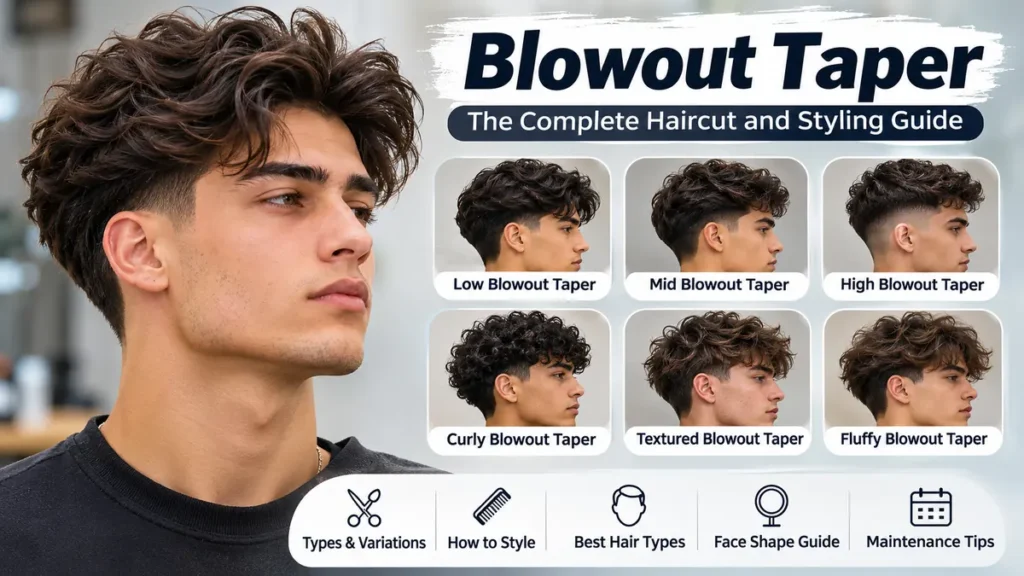
The blowout taper has become a popular men’s hairstyle because it combines natural volume on top with a clean, gradually shortened finish around the ears and neckline. It creates a distinctive silhouette without requiring the dramatic contrast of a skin fade.
A blowout taper is a men’s haircut that combines a voluminous, textured top with a gradual taper around the sideburns and neckline. The hair is typically styled upward, backward, or outward to create an airy, lifted appearance. It works with straight, wavy, and curly hair, although the final shape depends on hair texture and length.
The haircut can look relaxed and messy or polished and structured. Understanding the different variations, how the cut is created, and what maintenance it requires will help you decide which version suits your hair.
What Is a blowout taper?
A blowout taper combines two distinct haircutting and styling techniques: a blowout and a taper.
The blowout refers to the volume and movement created through cutting and styling the hair. A barber or stylist typically leaves enough length on top for the hair to lift away from the scalp. Blow-drying, brushing, and lightweight styling products can enhance this effect.
The taper refers to the gradual reduction in hair length around selected areas, particularly the sideburns and nape of the neck. Instead of removing most of the hair along the sides, the barber blends shorter hair into longer sections.
The result is a haircut with three recognizable features:
- A full, lifted top with visible movement and texture.
- A smooth transition around the ears and neckline.
- A relatively natural-looking connection between the longer top and shorter edges.
Unlike a traditional fade, which may extend across much of the sides and back, a classic taper usually concentrates the shortest hair near the perimeter.
However, haircut terminology varies between barbers. Some use blowout taper to describe a fluffy, high-volume hairstyle with a low taper, while others use it for a more dramatic shape with additional height and shorter sides.
Why is the blowout taper so popular?
The hairstyle offers a combination of volume, definition, and versatility.
Its fuller upper section allows the wearer to emphasize natural curls, create a messy textured finish, or style the hair into a controlled quiff. Meanwhile, the tapered edges prevent the haircut from appearing excessively bulky around the ears.
The style also adapts well to different preferences. Someone who wants a subtle everyday haircut can choose a low taper, while someone seeking stronger contrast can select a mid or high taper.
Social media haircut tutorials and short-form styling videos have also helped popularize textured, fluffy versions of the look.
Different Types of blowout taper Haircuts
The main variations are distinguished by where the taper begins, how much contrast it creates, and how the top is styled.
| Style | Main characteristics | Overall appearance |
|---|---|---|
| Low blowout taper | Short transition close to ears and neckline | Subtle and natural |
| Mid blowout taper | Taper begins around the middle of the sides | Balanced and defined |
| High blowout taper | Shorter sections extend higher on the head | Bold and contrasting |
| Curly blowout taper | Natural curls remain full on top | Rounded and textured |
| Textured blowout taper | Choppy layers and separated strands | Messy and modern |
| Fluffy blowout taper | Soft, airy volume with minimal stiffness | Relaxed and youthful |
| Blowout taper with fringe | Longer hair falls toward the forehead | Forward-focused and casual |
Low blowout taper
The low blowout taper is one of the more understated versions.
The shortest sections remain close to the sideburns and neckline, preserving much of the natural fullness along the sides and back. The longer top creates the main visual interest.
This variation works particularly well for someone who wants a tidy outline without sacrificing hair density or changing the overall silhouette too dramatically.
It is also a practical starting point for someone trying the style for the first time because the barber can preserve more length.
Mid blowout taper
A mid blowout taper introduces a more noticeable transition.
The shortening begins higher than a low taper, generally around the middle of the side sections, although exact placement depends on the barber’s interpretation.
This creates a stronger distinction between the voluminous top and the shorter areas near the ears.
The mid variation suits a wide range of styling approaches, including textured quiffs, loose waves, and controlled curls.
High blowout taper
A high blowout taper creates a more dramatic contrast between the top and sides.
The taper extends farther upward, removing additional bulk and emphasizing the height of the hairstyle.
It can work especially well with thick hair that naturally expands outward, but it requires careful blending to avoid an abrupt or disconnected appearance.
A high taper is not necessarily a skin fade. The barber can leave visible hair at the shortest point rather than shaving the area completely.
Curly blowout taper
The curly blowout taper combines naturally curly hair with clean, tapered edges.
Instead of straightening the curls, the barber preserves their shape and movement. The top may be cut into layers to control excess bulk while maintaining a rounded silhouette.
A diffuser can help dry curls with less disruption to their natural pattern. Curl cream or lightweight mousse can improve definition without making the hairstyle rigid.
The final appearance depends on curl tightness, density, shrinkage, and how the hair is dried.
Fluffy blowout taper
The fluffy variation emphasizes soft, lifted hair rather than sharply separated strands.
It is often associated with medium-length straight or wavy hair that can be styled upward and slightly forward.
A blow dryer and lightweight volumizing product help create the airy appearance. Heavy waxes and oily products can reduce lift, especially on fine hair.
The goal is controlled volume that still looks touchable and natural.
Textured blowout taper
A textured blowout taper uses layering and point-cutting techniques to introduce separation and movement.
Rather than forming one smooth, uniform shape, the top contains different lengths that produce a slightly irregular finish.
This style is especially useful for thick hair that otherwise forms a heavy, rounded mass.
Matte styling paste or texture powder can help define individual sections without creating a glossy finish.
blowout taper vs. Other Popular Haircuts
Several men’s hairstyles share characteristics with the blowout taper, but the differences matter when explaining the desired cut to a barber.
Blowout taper vs. taper fade
A taper describes a gradual reduction in hair length. A fade also involves a gradual transition, often continuing to very short hair or skin over a larger area.
A blowout taper generally keeps more fullness on the sides while emphasizing volume above.
A taper fade can be incorporated into a blowout hairstyle, but the two terms are not completely interchangeable.
| Feature | Blowout taper | Traditional taper fade |
|---|---|---|
| Top volume | Usually emphasized | Depends on hairstyle |
| Side length | Often retains more fullness | May become very short |
| Neckline | Gradually shortened | Gradually faded |
| Styling | Lift and texture are central | Styling varies |
| Contrast | Subtle to dramatic | Subtle to dramatic |
The distinction is particularly important when choosing between a low taper and a low skin fade.
Blowout taper vs. burst fade
A burst fade creates a curved, semicircular fade around the ear. It commonly leaves more length toward the back of the head.
A blowout taper usually focuses on a gradual shortening at the sideburns and neckline, without necessarily creating the rounded fade pattern around the ear.
Both styles can feature a voluminous top, but their side profiles differ.
Blowout taper vs. mullet
A mullet deliberately maintains greater length at the back of the head.
A blowout taper does not require an elongated back section. Its defining feature is the relationship between the lifted top and the tapered edges.
However, a blowout-inspired top can be combined with a modern mullet or textured mullet.
Blowout taper vs. textured fringe
A textured fringe emphasizes hair falling forward over the forehead.
A blowout taper emphasizes volume and lift, although some versions incorporate a fringe.
A person can therefore wear a blowout taper with a textured fringe, combining features of both styles.
Which Hair Types Work Best for a blowout taper?
The haircut can be adapted to different hair textures, but the styling process and finished shape will vary.
Straight hair
Straight hair can produce a smooth, airy blowout, particularly when it has sufficient length and density.
Fine, straight hair may need mousse or a root-lifting product to maintain volume. Thick, straight hair may benefit from internal layering to prevent the top from looking overly heavy.
Blow-drying against the natural direction of growth can create temporary lift.
Wavy hair
Wavy hair is particularly adaptable because its natural bends add movement and volume.
A medium-length top can create a relaxed, tousled shape without extensive heat styling.
Sea salt spray may add texture, although frequent use can leave some hair feeling dry. A lightweight mousse is another option for enhancing definition.
Curly hair
Curly hair naturally provides volume, making it well suited to fuller blowout silhouettes.
The main challenge is balancing height, width, and definition. Excessive thinning may create unwanted frizz or disrupt the curl pattern.
A barber experienced with curly hair can shape the haircut according to how the curls sit when dry.
Coily hair
Coily hair can create a striking blowout taper with a full, sculpted top.
Depending on the desired finish, the hair can remain in its natural coil pattern or be gently stretched using appropriate styling techniques.
Moisture retention and careful detangling are particularly important when using heat or manipulating tightly curled hair.
Fine or thinning hair
Fine hair can work with a blowout taper, but a very long or heavily layered top may collapse without sufficient density.
A shorter, textured version may provide a fuller visual appearance.
For noticeably thinning areas, the haircut should be tailored to the existing hair distribution rather than relying on excessive teasing or high-heat styling.
How to Ask Your Barber for a blowout taper
Clear communication is one of the most effective ways to achieve the intended haircut.
Because the name can describe several variations, simply asking for a blowout taper may not provide enough information.
Step 1: Choose the taper height
Decide whether you want a low, mid, or high taper.
A low taper preserves more length and produces a softer transition. A high taper removes more bulk and creates a stronger contrast.
Explain whether you want the shortest area to remain visibly covered with hair or fade down to the skin.
Step 2: Specify the top length
The amount of hair left on top determines how much volume and movement can be created.
For many straight or wavy versions, approximately 3–5 inches (7.5–12.5 cm) provides useful styling flexibility, although shorter and longer variations are possible.
Curly hair should be assessed with shrinkage in mind because its stretched length can differ considerably from its dry appearance.
Step 3: Describe the shape
Tell the barber whether you prefer a rounded, fluffy silhouette, a taller quiff, or a more controlled textured top.
Also explain whether you want the hair to move forward, backward, or outward.
This is often more helpful than focusing exclusively on clipper guard numbers.
Step 4: Discuss the neckline and sideburns
Ask for a natural taper, a sharper outline, or a skin-level finish according to your preference.
A natural neckline generally grows out more softly, while a sharply defined edge may require more frequent maintenance.
Step 5: Show reference photos
Bring photographs showing the front, sides, and back of the desired haircut.
Choose examples with a similar hair texture and density to your own. A photograph of very thick, wavy hair may not accurately represent how the same cut will behave on fine, straight hair.
A useful instruction is:
Keep the top long enough for a textured, lifted blowout. Give me a low taper around the sideburns and neckline, blend it naturally into the longer hair, and avoid taking the sides too short.
The barber can then adjust the details according to your hair growth pattern and head shape.
How to Style a blowout taper at Home
A well-executed haircut provides the foundation, but styling determines whether the top appears fluffy, defined, or structured.
For straight and wavy hair, blow-drying is often the easiest way to create the characteristic lift. Curly and coily hair may achieve a similar silhouette through natural volume, careful shaping, and curl-friendly drying techniques.
Step 1: Start with clean, slightly damp hair
Wash your hair with a shampoo appropriate for your scalp and hair type. Use conditioner when needed, especially if your hair tends to become dry or tangled.
Gently remove excess moisture with a microfiber towel or soft cotton T-shirt.
Avoid aggressively rubbing the hair, which can increase tangling and frizz.
Step 2: Apply a lightweight styling product
Choose a product according to the finish you want.
- Volumizing mousse: Helps fine or straight hair maintain lift.
- Texture spray: Adds separation and a slightly tousled finish.
- Curl cream: Enhances definition in curly and coily hair.
- Heat protectant: Helps reduce damage from blow-drying and other heated styling tools.
- Lightweight leave-in conditioner: Helps manage dryness and improve softness.
Start with a small amount. Excess product can weigh down the hair and reduce the airy appearance.
Step 3: Blow-dry for volume
For straight or wavy hair, direct airflow toward the roots while lifting sections with your fingers or a vent brush.
Use a low or medium heat setting and keep the dryer moving rather than concentrating heat on one spot.
To create a fluffy finish, lift the front sections upward and slightly backward. For a textured fringe, direct the hair forward while maintaining some root volume.
A cool-air setting can help finish the style.
For curly hair, use a diffuser with gentle airflow to reduce disruption to the curl pattern.
Step 4: Shape the top
Once the hair is mostly dry, arrange it into the desired silhouette.
A matte paste can add definition to thick or textured hair. Fine hair may respond better to a small amount of texture powder or lightweight styling cream.
For curls, scrunching can enhance definition without separating every curl.
Avoid repeatedly brushing dry curls if you want to preserve their natural pattern.
Step 5: Finish without overloading the hair
The hairstyle should retain movement.
If additional hold is necessary, use a light application of flexible-hold hairspray. Avoid applying multiple heavy products simply to maintain height.
A successful blowout should look full without feeling excessively stiff or coated.
Choosing a blowout taper for Your Face Shape
Face shape can influence how the hairstyle appears, but it should not be treated as a strict rule.
Hair density, growth direction, forehead proportions, and personal styling preferences often matter just as much.
| Face shape | Styling approach to consider |
|---|---|
| Round | Moderate height with controlled width |
| Oval | Most taper heights and top shapes can be explored |
| Square | Soft texture to balance angular features |
| Oblong | Moderate top height with some side fullness |
| Heart-shaped | Fuller sides and controlled height |
| Diamond | Preserve some volume around the temple area |
Round faces
A lifted top can create a more elongated visual effect.
A mid taper with controlled side volume may provide a balanced silhouette. Excessive width around the upper sides can make the overall shape appear rounder.
Oval faces
Oval faces often accommodate a broad range of hairstyles.
Low, mid, and high blowout tapers can all work, depending on hair texture and preferred contrast.
The choice can focus more on maintenance and styling effort than on correcting proportions.
Square faces
A square face typically features a more angular jawline.
Soft waves, loose texture, or a fluffy top can provide visual contrast to these features.
A low or mid taper can preserve some side fullness while maintaining a clean outline.
Oblong faces
Very tall hairstyles may emphasize the length of an already elongated face.
A moderately lifted top with additional width through the upper sides can create a different balance.
A low taper is worth considering when preserving side volume is a priority.
Heart-shaped and diamond faces
These face shapes may have comparatively narrow jawlines or pronounced cheekbones.
Keeping some fullness near the temples can help balance the hairstyle’s silhouette.
A very high taper removes more side hair, so a lower transition may be preferable when the goal is a softer appearance.
These are visual guidelines rather than universal rules. A hairstyle that suits your natural texture and preferred appearance is more important than following a face-shape formula.
How Long Does a blowout taper Last?
The haircut does not have a fixed lifespan. Hair growth, taper height, and the sharpness of the original outline all affect how quickly the style changes.
The shorter sections generally lose their freshly cut definition before the longer top requires significant reshaping.
Typical maintenance schedule
| Maintenance task | Approximate frequency |
|---|---|
| Restyle the top | As needed |
| Refresh the sideburns and neckline | Every 1–3 weeks |
| Full haircut and reshaping | Every 3–6 weeks |
| Adjust top length | Based on growth and preferred shape |
| Deep conditioning | As appropriate for hair condition |
These intervals are estimates, not requirements.
Someone with a soft low taper may be comfortable allowing the haircut to grow for several weeks. A high, skin-close taper may show noticeable regrowth much sooner.
How can you make the haircut last longer?
Preserving the overall shape is more useful than trying to maintain a perfectly sharp outline indefinitely.
Keep the hair clean, avoid excessive product buildup, and style the top in its intended direction.
If the neckline becomes untidy, a minor cleanup may restore definition without requiring a complete haircut.
Avoid attempting to raise the taper yourself with clippers unless you have the appropriate skills. Removing too much hair can change the blend and create an uneven transition.
Common blowout taper Mistakes to Avoid
Even a technically well-blended taper can produce disappointing results if the top is cut or styled incorrectly.
Cutting the top too short
A blowout needs sufficient length to create visible movement.
Removing too much hair can leave the top looking flat or prevent it from forming the intended shape.
Before cutting, discuss how much length is required for your specific hair texture.
Removing too much weight from the sides
Some blowout styles depend on a fuller transition between the top and sides.
If the barber takes the fade too high or removes too much bulk, the haircut may develop an exaggerated separation.
Explain whether you want a rounded silhouette or a narrower, more disconnected shape.
Using excessive heat
High temperatures can contribute to dryness and breakage, especially with repeated styling.
Use appropriate heat protection, moderate temperatures, and sufficient distance between the dryer and hair.
Curly and coily hair can often achieve volume with air-drying or gentle diffusing instead.
Applying too much styling product
Heavy pomades, waxes, and creams can make a blowout appear greasy or flattened.
Choose products according to hair density and texture.
Fine hair usually benefits from lighter formulas, while thicker hair may tolerate stronger styling products.
Ignoring natural growth patterns
Cowlicks, crown direction, and hairline growth patterns influence how hair sits.
Forcing the hair into a shape that conflicts strongly with its natural direction may require additional styling time.
An experienced barber can adapt the haircut to these characteristics rather than treating every head of hair identically.
Choosing a reference photo with a different hair texture
A fluffy blowout on thick, naturally wavy hair may not look identical on fine, straight hair.
The same taper placement can produce a noticeably different result depending on density and curl pattern.
Use reference images as guidance while allowing the barber to adjust the haircut realistically.
Can You Get a blowout taper Without Using a Blow Dryer?
Yes. A blow dryer is not mandatory for every version of the haircut.
The term blowout describes the overall volume and silhouette, but that shape can sometimes be achieved through natural texture.
Curly and coily hair may already have sufficient lift. A suitable layered cut, curl cream, and air-drying can produce a full top without extensive heat styling.
Wavy hair may also develop natural volume when scrunched with mousse and left to dry.
Straight hair generally requires more deliberate styling to create the same lifted appearance, although a textured cut and lightweight volumizing product may provide some movement without heat.
The main difference is consistency. Blow-drying offers greater control over direction and height, while air-drying allows the hair’s natural growth pattern to determine more of the final shape.
If you prefer a low-maintenance routine, ask your barber to create a version that looks acceptable when air-dried.
Is the blowout taper a Low-Maintenance Haircut?
The answer depends on the chosen variation and natural hair texture.
A low taper with naturally curly or wavy hair may require relatively little daily styling. The hair already has movement, and the taper can grow out gradually.
A fluffy, straight-haired blowout may require blow-drying and styling products to maintain its height.
A high taper with a sharply defined neckline may need more frequent barber visits to preserve the contrast.
The haircut is therefore best understood as having two separate maintenance requirements: keeping the tapered edges tidy and maintaining the desired shape on top.
For someone who prefers minimal styling, preserving natural texture and choosing a softer low taper can reduce the amount of daily work.
How to Grow Out a blowout taper
Growing out the haircut is generally straightforward because the taper already connects shorter hair to longer sections.
The most important decision is whether you want to preserve the blowout shape or transition into a different hairstyle.
If you want to maintain the volume on top, allow the upper sections to grow while periodically cleaning up the sideburns and neckline.
If you want a longer, more uniform haircut, reduce the frequency of taper cleanups and let the shorter areas catch up.
During the transition, the sides may temporarily appear fuller or less defined. Light trimming and careful styling can help maintain a balanced appearance.
Avoid repeatedly cutting the top simply because the sides are growing unevenly. Doing so can delay progress toward a longer hairstyle.
Final Thoughts on the blowout taper
The blowout taper combines a full, textured top with gradually shortened edges, creating a hairstyle that can range from subtle and natural to bold and sharply defined.
Its versatility comes from the ability to adjust taper height, top length, styling direction, and texture. Straight hair can achieve a fluffy, lifted finish, while wavy, curly, and coily hair can use natural movement to create volume.
The most reliable way to achieve the desired result is to communicate clearly with your barber. Specify the taper height, how much side fullness you want to retain, and the shape you expect on top.
Choose a version that works with your natural hair texture and the amount of time you are comfortable spending on daily styling. A well-balanced haircut should look good not only immediately after leaving the barbershop but also as it grows and settles into your regular routine.