
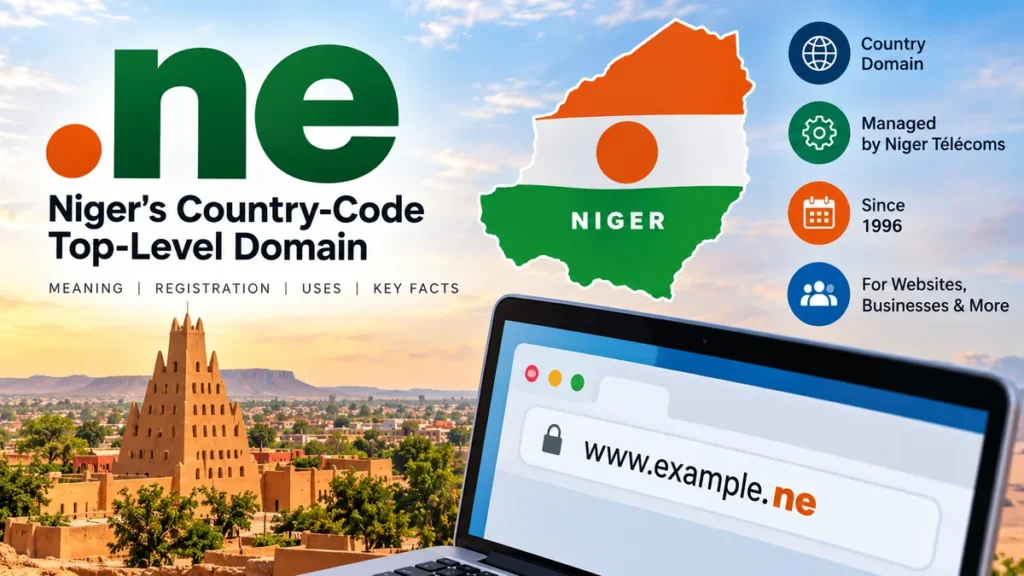
The .ne, keyword usually points to .ne, the country-code top-level domain assigned to Niger. If you have encountered a web address ending in .ne, that ending identifies the domain as part of Niger’s national namespace in the Domain Name System (DNS). The extension is active and has existed since 1996.
Quick answer: .ne is Niger’s Internet country-code top-level domain, or ccTLD. IANA lists Niger Télécoms SA as its current ccTLD manager and records April 24, 1996 as its registration date. Like .fr for France or .ng for Nigeria, .ne provides a country-associated namespace for websites and other Internet services.
What Does .ne, Mean?
When .ne, appears in a search or discussion about websites, it will generally be interpreted as the .ne domain extension.
A domain extension is the final portion of a domain name. For example, in:
example.ne
example is the second-level label, while .ne is the top-level domain.
The Internet Assigned Numbers Authority (IANA) classifies .ne as a country-code top-level domain (ccTLD) associated with Niger.
Country-code domains are generally based on two-letter country or territory identifiers. Familiar examples include .uk, .de, .fr, .jp, and .ng.
The .ne extension performs the same basic DNS function while identifying Niger at the top level of the domain hierarchy.
.ne, at a Glance
| Feature | Information |
|---|---|
| Domain extension | .ne |
| Domain type | Country-code top-level domain (ccTLD) |
| Country | Niger |
| Status | Active |
| Registration date | April 24, 1996 |
| Current IANA-listed manager | Niger Télécoms SA |
| Registry location | Niamey, Niger |
| Registration information | intnet.ne |
These details come from IANA’s current delegation record, which was updated on September 7, 2026.
What Country Uses the .ne, Domain?
The country associated with .ne, is Niger, a West African country.
This point can cause confusion because several African country extensions look similar:
| Extension | Country |
|---|---|
.ne | Niger |
.ng | Nigeria |
.na | Namibia |
.ni | Nicaragua |
.nl | Netherlands |
Most importantly, .ne should not be confused with .ng. IANA identifies .ne as Niger’s country-code domain and .ng as Nigeria’s.
The similarity matters when typing addresses manually. Changing only one letter can lead to an entirely different national domain namespace.
Who Manages the .ne Domain?
According to IANA’s current Root Zone Database, Niger Télécoms SA (NIGERTELECOMS) is the ccTLD manager for .ne. Its listed address is in Niamey, Niger.
The delegation record also identifies administrative and technical contacts associated with Niger Télécoms.
This management role should not be confused with IANA’s role.
Registry Manager vs. IANA
The distinction is useful when learning how country domains work.
IANA maintains authoritative information about top-level-domain delegation within the DNS root. The local ccTLD manager handles the national domain’s operational and registration framework.
For .ne, the current IANA record points users seeking registration services to intnet.ne.
Third-party websites sometimes still identify the operator as SONITEL, the organization’s earlier identity. Current information should therefore be checked against IANA rather than relying on an older registrar or directory page.
Quick Takeaway: If two websites disagree about who currently operates .ne, use the current IANA delegation record as the authoritative starting point.
When Was .ne, Created?
IANA records April 24, 1996 as the registration date for .ne.
That makes it a traditional country-code domain rather than one of the many newer generic top-level domains introduced during later expansion of the domain-name system.
The distinction matters.
.ne represents a geographic country-code namespace. Extensions such as .network, meanwhile, are generic TLDs rather than Niger-specific country codes. IANA’s Root Zone Database lists .ne as country-code and .network as generic.
How Does a .ne Domain Work?
A .ne domain works through the same hierarchical Domain Name System used by .com, .org, .net, and other extensions.
Consider:
example.ne
A simplified DNS lookup works like this:
- A user enters the domain into a browser.
- A DNS resolver begins resolving the requested hostname.
- The DNS root directs the lookup toward the
.nenamespace. - The
.neauthoritative infrastructure identifies the appropriate nameservers for the registered domain. - Those authoritative servers provide the relevant DNS records.
- The browser can then connect to the destination service when the required records resolve correctly.
The .ne extension therefore isn’t simply a visual country label. It participates in the technical DNS hierarchy.
Which Nameservers Support .ne,?
IANA currently lists four authoritative nameserver hosts for .ne:
bow.rain.frne.cctld.authdns.ripe.netns-ne.afrinic.netns.intnet.ne
Both IPv4 and, for some servers, IPv6 addresses appear in the delegation record.
Two organizations visible in those hostnames are also notable: RIPE NCC and AFRINIC, regional Internet infrastructure organizations.
Multiple authoritative nameservers provide resilience. A top-level domain cannot reasonably depend on one server because failures could otherwise affect resolution across the entire namespace.
Can You Register a .ne, Domain?
Registration of .ne domains exists, but availability and procedures can be less straightforward than buying mainstream extensions such as .com.
IANA currently directs people looking for .ne registration information to the registry service at intnet.ne.
Some specialized international registrars also advertise .ne registration. Their prices, requirements and supported second-level categories can differ considerably. For example, third-party domain comparison services list direct .ne registrations alongside categories such as .com.ne, .org.ne, .info.ne, .int.ne, and .perso.ne.
Because registry policies and registrar support can change, prospective registrants should verify current requirements rather than relying on an old article.
Check These Details Before Registration
Before trying to register a .ne name, confirm:
- whether direct second-level registration is available;
- whether the registrar supports your country;
- current registration and renewal fees;
- minimum registration period;
- eligibility or documentation requirements;
- DNS management options;
- nameserver requirements;
- transfer procedures;
- renewal and expiration rules.
This is particularly important for less commonly offered ccTLDs because different registrars may provide very different levels of support.
What Is the Difference Between .ne and .com.ne?
These addresses operate at different levels of the namespace.
Consider:
business.ne
versus:
business.com.ne
In the first example, business is registered directly beneath .ne.
In the second, business sits beneath the .com.ne structure.
Third-party registrar directories currently advertise several .ne sub-level categories, including .com.ne, .info.ne, .int.ne, .org.ne, and .perso.ne.
The right structure depends on what the registry currently permits and what type of organization or website is involved.
Is .ne the Same as .net?
No. This is one of the most important distinctions surrounding .ne, searches.
.ne and .net are separate top-level domains.
| Feature | .ne | .net |
|---|---|---|
| Type | ccTLD | Generic TLD |
| Geographic association | Niger | None required |
| Characters | 2 | 3 |
| Main role | National domain namespace | General-purpose global namespace |
IANA’s Root Zone Database classifies .ne as a country-code TLD and .net as a generic TLD managed by VeriSign Global Registry Services.
This distinction also creates a practical risk: a person intending to type a .net address could accidentally omit the final t and enter a .ne domain instead.
Historical descriptions of .ne have specifically noted its association with typo-based uses involving .net addresses.
For that reason, always verify the full domain before entering passwords, payment information, or other sensitive data.
.ne, and Typosquatting
Typosquatting occurs when someone registers a domain resembling another web address in the hope that users will reach it through a typing mistake.
Because .ne differs from .net by only one character, the extension has historically attracted attention in discussions of this practice.
Imagine that the legitimate address were:
example.net
A user accidentally entering:
example.ne
would be requesting a completely different domain.
That does not mean .ne domains are inherently suspicious. .ne is a legitimate national ccTLD for Niger. The issue is simply that its spelling can resemble .net.
How to Avoid Domain-Typo Problems
Check the complete address before signing in or entering sensitive information. Browser bookmarks are useful for frequently visited financial, business and account-management sites.
Also pay attention to:
HTTPS: Encryption protects the connection but does not by itself prove that a website is the organization you intended to visit.
Domain spelling: Look at the actual registered domain rather than only the page design.
Unexpected redirects: A redirect from a familiar-looking address to an unrelated domain deserves additional scrutiny.
Email links: Verify destinations before following unexpected account or payment links.
These practices apply to every domain extension, not just .ne.
Is .ne, Used Only in Niger?
A country-code extension identifies a national namespace, but that does not automatically mean every website using it is physically hosted in that country.
Three concepts are often mixed together:
Domain registration determines who controls a particular domain name.
Registry administration concerns management of the top-level namespace.
Web hosting determines where the website’s content and server infrastructure operate.
A .ne website could therefore use DNS, hosting, content-delivery or other infrastructure located outside Niger.
Likewise, seeing .ne in an address tells you something about the domain namespace but does not prove where the site’s owner, visitors or servers are physically located.
Does .ne, Help With SEO in Niger?
A country-code top-level domain provides a strong geographic association because the extension itself corresponds to a country.
For organizations specifically serving Niger, a .ne domain can therefore communicate geographic relevance clearly to users.
But a ccTLD alone does not guarantee search rankings.
Search visibility still depends on fundamentals such as:
- useful and relevant content;
- crawlability and indexability;
- page quality;
- internal linking;
- website architecture;
- performance;
- backlinks and reputation;
- language and geographic relevance;
- accurate technical configuration.
A domain extension should therefore be viewed as one geographic signal within a much larger search ecosystem rather than an automatic ranking advantage.
.ne, vs Other Country-Code Domains
The basic concept behind .ne becomes clearer when compared with other ccTLDs.
A country-code top-level domain normally consists of two letters associated with a country or territory. .ne identifies Niger, while neighboring or regional countries have their own namespaces.
For example, Nigeria uses .ng. IANA lists the Nigeria Internet Registration Association as the manager of .ng, while Niger’s .ne record currently identifies Niger Télécoms SA.
Each country-code registry can establish its own registration structures and administrative policies. You therefore cannot assume that rules applying to .ng, .fr, .uk, or another ccTLD automatically apply to .ne.
Is “ne” Always a Top-Level Domain?
No.
Context matters because the letters ne can appear at different levels within domain names.
For example, some countries have historically used ne as a second-level category beneath their own ccTLD. Japan’s .ne.jp is a useful example. In that address structure, .jp is the country-code top-level domain—not .ne.
Compare:
example.ne
Here, .ne is the TLD.
example.ne.jp
Here, .jp is the TLD, while ne forms part of the hierarchy underneath it.
Looking only for the letters “ne” without examining the complete hostname can therefore produce the wrong interpretation.
How Can You Verify Information About .ne,?
For authoritative top-level-domain information, start with IANA’s Root Zone Database.
IANA .ne Delegation Record
The record provides the current ccTLD manager, administrative and technical contact information, authoritative nameservers, registration-service reference, registration date and delegation status.
For dispute-policy context, the World Intellectual Property Organization’s ccTLD database also identifies .NE with Niger.
Third-party registrar sites can still be useful for comparing registration availability and pricing, but registry-level facts should be checked against authoritative sources when information conflicts.
Why Do Different Websites Show Different .ne Information?
This is a particularly useful question because .ne information across the web is not always consistent.
Older pages may still identify SONITEL as the registry organization, while IANA’s current delegation page identifies Niger Télécoms SA (NIGERTELECOMS).
Third-party sites can also disagree about registration restrictions, operators, dates, availability and domain counts.
There are several reasons:
Registry organizations can change names or structures. Websites may retain old WHOIS information. Registrar databases may update on different schedules. Some services also derive their information automatically rather than directly from the current delegation record.
For current technical facts, checking the date of the source is therefore essential.
Quick Takeaway: Domain information is dynamic. Treat current IANA delegation data as the baseline and registrar information as supplementary when researching .ne.
Understanding the DNS Structure Behind .ne,
The Domain Name System is hierarchical.
At the top is the DNS root. Beneath the root are top-level domains such as .com, .org, .net, .ne, and thousands of others.
A simplified hierarchy looks like this:
DNS Root → .ne → example.ne → www.example.ne
Each level can delegate authority downward.
The root does not need to contain every website’s IP address. Instead, it identifies the authoritative infrastructure responsible for the appropriate top-level domain.
The .ne registry infrastructure then enables DNS delegation for domains within its namespace.
This distributed model is one of the reasons DNS can operate at Internet scale.
What Should Website Owners Know Before Using .ne,?
A .ne address can make sense when a project has a meaningful relationship with Niger or specifically needs the namespace.
The domain itself, however, is only one part of running a reliable website.
Owners should make sure their domain has properly configured authoritative nameservers and DNS records. Web services commonly depend on A or AAAA records, while email configuration can require MX records plus authentication-related TXT records.
Renewal deserves equal attention. Losing control of a domain because of an expired registration can disrupt the website, email and other services simultaneously.
Security practices also matter. Registrar accounts should use strong authentication where available, and organizations should keep administrative contact information current.
Final Takeaway on .ne,
The most useful interpretation of .ne, in an Internet-domain context is .ne, the country-code top-level domain for Niger. IANA currently lists it as active, records its registration date as April 24, 1996, and identifies Niger Télécoms SA as the ccTLD manager.
It should not be confused with .net or Nigeria’s .ng. It can appear in direct domains such as example.ne, while related structures such as .com.ne may also be offered through specialized registration services.
When researching or registering a .ne, domain, the practical next step is to verify current delegation and registration information from authoritative sources, because registry details, registrar support, prices and eligibility rules can change over time.


