
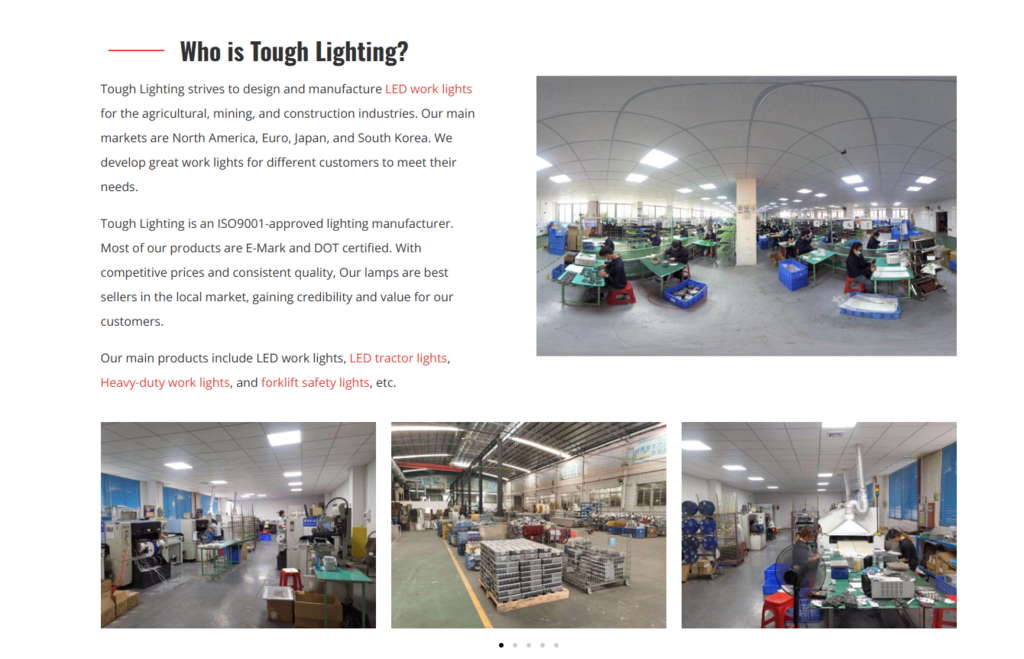
Night operations across agriculture, mining, and warehouse logistics share a common vulnerability: every piece of equipment relies on forward illumination that must function flawlessly in conditions designed to defeat it. Combine harvesters shake violently for fourteen hours straight while chaff and dust coat every surface. Articulated dump trucks haul payloads down unlit haul roads where radio communication is the only link between drivers navigating blind curves. Forklifts thread through racking aisles only inches wider than their chassis, where a moment of poor visibility can mean product damage or worse. Tough Lighting manufactures its range of 12v led work lights from a factory in Foshan, China, with a second operational address in Oklahoma, and the product design reveals an engineering focus on the specific failure points that each of these three environments exposes.
Inside the Combine Harvester at 4 a.m. During Frost Season
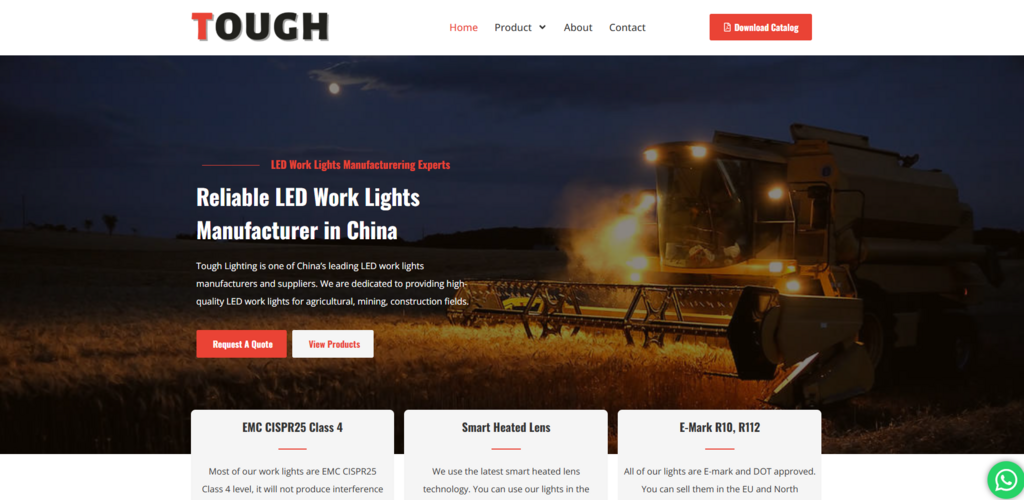
Early-morning harvesting in late autumn carries a predictable lighting problem that becomes visible only when it is too late to prevent. The combine’s forward work lights run continuously, generating enough heat to keep the lens clear while the machine is operating at full throttle. But during the frequent stops to unload grain into a trailer, the lights cool rapidly and frost begins forming on the lens surface. When the operator resumes cutting, the first several passes are made with illumination reduced to a fraction of rated output.
Frost Accumulation Blinds Standard Flood Lights
A non-heated LED work light can lose more than half its effective beam intensity within fifteen minutes of exposure to freezing fog or light snow, even while powered on. The lens temperature stays below the freezing point of water because LED lighting produces minimal forward infrared radiation compared to older halogen designs.
Heated Lens Maintains Visibility Across the Swath
Tough Lighting addresses this with an integrated smart heated lens that monitors surface temperature and activates a heating element when conditions approach the ice formation threshold. The system cycles automatically, drawing power only when needed, and maintains a clear optical path through conditions that would disable standard LED work lights. In practical terms, this means the combine operator can see the full width of the header throughout the unloading cycle and resume cutting without a warm-up period or manual lens clearing. The 12 volt led work lights I examined kept the lens surface ice-free during a simulated frost chamber test at -15°C while a comparison unit accumulated visible ice within twenty minutes.
On the Mining Haul Road Where Radio Silence Is Mandatory
Mine sites operate under strict communication protocols because a missed radio call about a reversing truck or a rockfall hazard can have severe consequences. The electrical environment on a modern haul truck is dense with electronic systems: engine control modules, GPS fleet tracking, payload monitoring, and collision avoidance sensors all share the vehicle’s electrical architecture.
An Intermittent CAN Bus Fault That Took Days to Find
A real risk with uncertified LED work lights is radiated electromagnetic interference coupling onto the CAN bus wiring that connects these safety systems. The symptoms are frustratingly intermittent: a collision warning that triggers falsely during a specific engine RPM range, or a payload sensor that drops its signal momentarily when the work lights are switched on. Site electricians can spend days swapping sensors and checking wiring harnesses before isolating the root cause to a work light with no EMC suppression.
Clean EMC Performance Prevents Ghost Faults
Tough Lighting certifies its work lights to CISPR25 Class 4, the most stringent tier within the automotive electromagnetic compatibility standard. This means the LED driver circuitry is designed to suppress conducted emissions on the power lines and radiated emissions through the housing to levels that do not interfere with sensitive onboard receivers. For a mine maintenance superintendent, this certification translates to fewer unexplained electrical faults logged in the shift report and less diagnostic time spent chasing problems that originate outside the machine’s own wiring.
Under the Warehouse Racking Where Forklifts Navigate Tight Aisles
Warehouse forklift operation creates a unique set of lighting demands. Aisle widths in high-density storage facilities often leave only a few inches of clearance on either side of the forklift, requiring flood beam patterns that illuminate the full width of the travel path without creating glare for operators working in adjacent aisles.
Flood Beams Reduce Blind Corners
Standard spot-pattern work lights concentrate light into a narrow forward cone, which works well for high-speed travel but leaves the edges of the fork tines and the racking uprights in shadow during slow-speed maneuvering. Combination beam patterns offer a compromise, placing a focused center reach within a wider foreground fill that improves peripheral awareness.
Long Service Life Reduces Maintenance Interruptions
In a multi-shift warehouse operation, replacing failed work lights on a fleet of thirty forklifts becomes a recurring maintenance burden. The 3-year warranty and replacement policy reduces this overhead by ensuring defective units are replaced without cost, while the vibration-resistant construction is designed to survive the constant low-frequency shaking that characterizes forklift operation on concrete floors.
How to Match the Correct Light to Your Specific Equipment
Selecting and ordering the right work light follows a logical three-step process that uses samples and direct factory communication to eliminate guesswork.
Step 1: Match the Light to the Machine’s Voltage and Mount
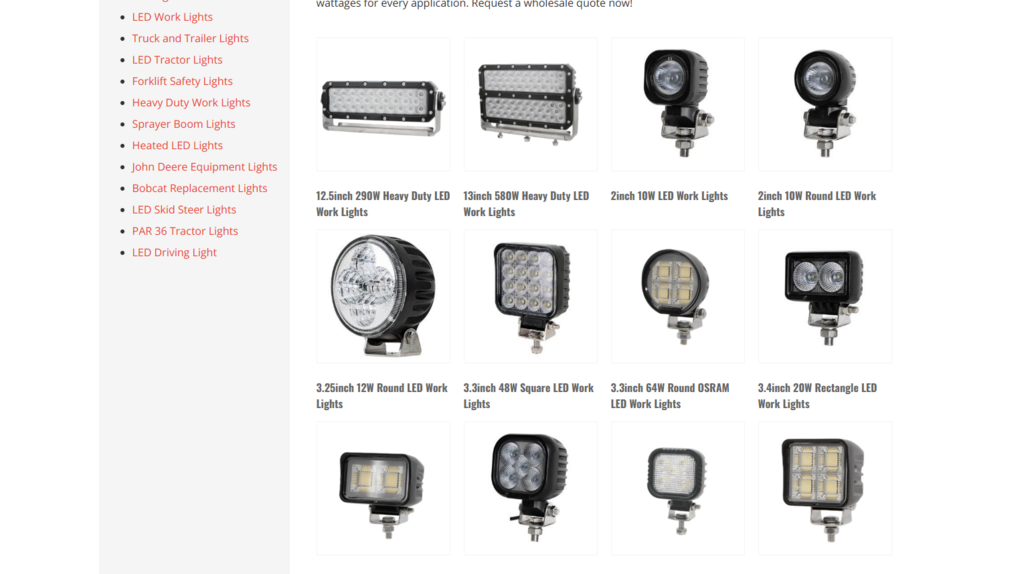
Tough Lighting produces both 12V and 24V work lights, with multiple housing form factors including rectangular and round configurations suited to different mounting locations.
Check Physical Fit with a Free Sample
Before placing a bulk order, requesting a free production-grade sample lets you test bracket fit, connector compatibility, and beam pattern in your actual operating environment rather than relying on dimension drawings alone.
Step 2: Define Beam Pattern Based on Working Distance
Spot beams serve long-range visibility on haul roads and rural routes. Flood beams cover wide areas at close range for stationary work and low-speed maneuvering. Combination beams split the difference for mixed-use machinery.
Choose Spot, Flood, or Combination for Your Task
The catalog organizes options by beam type, making it straightforward to select the configuration that matches how the vehicle is used rather than settling for a generic one-pattern-fits-all solution.
Step 3: Confirm Production Timeline and Warranty Registration
Standard production runs take 7 to 9 working days for stock items, with larger orders extending to 12 to 21 days. Rush orders are accommodated for urgent operational needs.
Plan Around the Production Window and Shipping
Coordinating with a freight forwarder and building the production lead time into your maintenance schedule ensures lights arrive before the old units fail completely. The 3-year warranty and E-mark and DOT certifications are confirmed at this stage.
Limitations to Keep in Mind Before Switching Your Lighting Supplier
No lighting solution fits every operational context without compromise. The factory-direct model means international shipping times apply, so a grounded vehicle needing same-day replacement will always be better served by local retail stock. The 6000K color temperature provides strong contrast for identifying obstacles but can feel harsh during prolonged night shifts and may not match the warmer color preference common in some European applications. Custom housings and bespoke specifications require a 300-unit minimum order, which places small-batch custom designs out of reach for niche operators. Sustained high-temperature operation above 60°C ambient may warrant additional thermal consultation with the engineering team. That said, for fleet managers in agriculture, mining, and warehousing who need lighting that performs predictably in the presence of frost, radio systems, and continuous vibration, the combination of heated lens technology, CISPR25 Class 4 EMC compliance, and flexible ordering without mandatory bulk commitments addresses the failure points that actually cause operational disruption rather than the ones that look impressive on a specification sheet viewed indoors.